
Carroll Projected and Actual Release
A projected release date is a calculation based on information recorded at a certain point. It is not the same as the actual date and time a facility completes an exit. IDOC records commonly use labels such as Projected Parole Date and Projected Discharge Date, alongside Parole Date. The exact live label matters. A projected parole date can relate to expected prison exit into supervision. A projected discharge date can refer to the expected end of the legal term. Neither is automatically a Carroll County jail release date.
Pretrial custody works differently. A person awaiting court action has no sentence-based date to calculate. A judge may enter a pretrial release order, yet jail processing, conditions, another warrant, or a receiving-agency hold can affect what follows. The Carroll court order establishes legal authority. The Sheriff’s final custody disposition establishes the physical event.
- Projected parole date
- An IDOC calculation for a possible prison-release point under the recorded sentence and credits.
- Projected discharge date
- An expected end point for the applicable IDOC term, which may differ from prison exit.
- Detainer
- A request or authority that can lead to transfer or continued custody after one term ends.
- Presentence credit
- Time credited from custody before the sentence, as recorded by the court and agency.
Find Carroll Inmate Release Dates
Classify the custody episode before searching. A short Carroll County jail stay will not produce an IDOC projected date. A person sentenced to Illinois prison may be assigned anywhere in the state, even though the case began in Carroll County. A federal prisoner at FCI Thomson belongs in BOP records, not the Sheriff or IDOC calculation.
- Read the sentencing judgment or latest court order. Identify pretrial custody, a county jail term, an IDOC commitment, or a federal sentence.
- For IDOC, open the Individual in Custody Search. Match the IDOC number, birth date, sentencing facts, and other descriptors.
- Record every date with its exact label and retrieval date. Keep Projected Parole Date, Parole Date, and Projected Discharge Date distinct.
- For a Carroll County jail term, use the court’s custody-credit entry and request the Sheriff’s current recorded calculation. Do not copy an IDOC formula.
- For a federal term, use the BOP locator’s projected release date and applicable federal record, including any First Step Act caveat.
- Check for later orders, credit changes, revocation, consecutive sentences, and detainers. After the event, obtain the actual disposition.
The IDOC public interface can be unavailable or incomplete. A no-result may mean the person was discharged, never entered IDOC, remains in county custody, or was not matched correctly. Use the court judgment and a focused IDOC record request when the displayed result cannot establish the needed history.
The official IDOC search-field source is shown below.
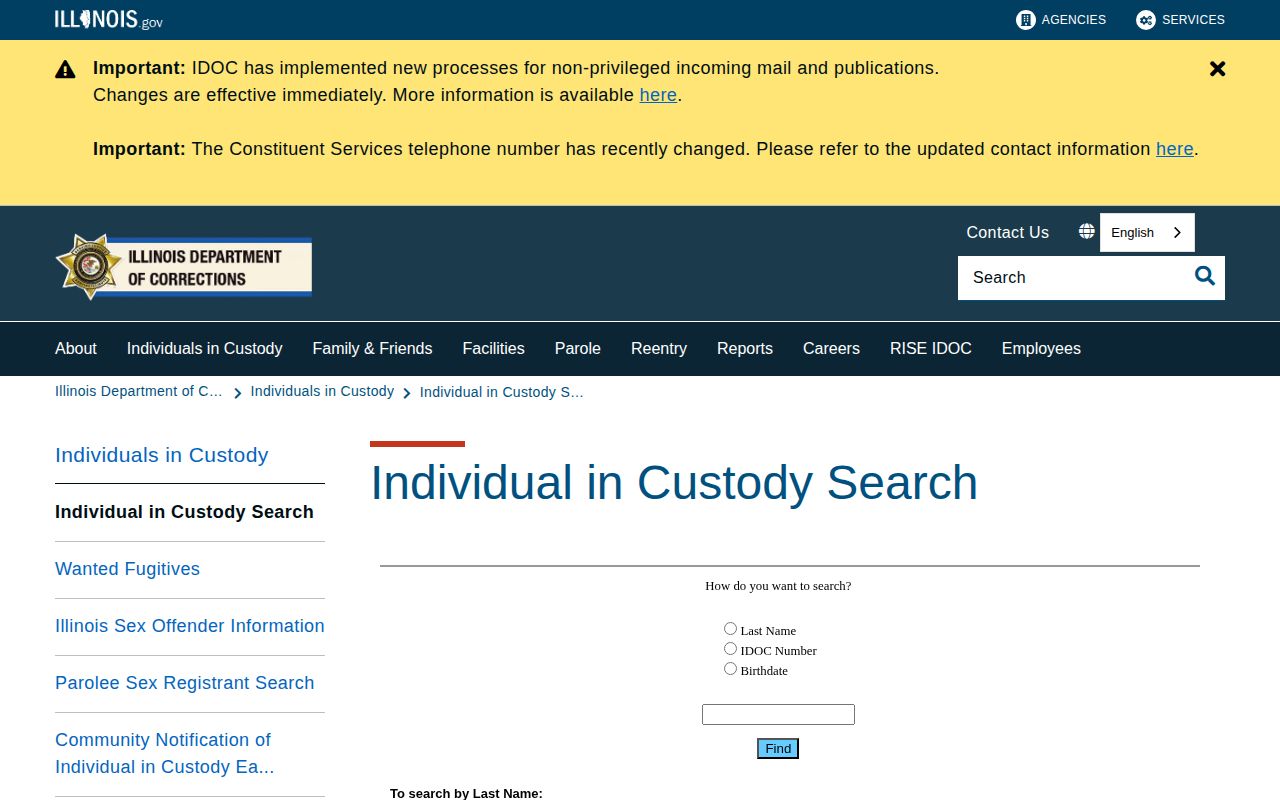
The captured interface identifies the state-prison search route. It does not calculate a county jail term or guarantee that a displayed future date will occur.
Illinois Credits Are Not One Rule
Carroll County state-prison calculations follow 730 ILCS 5/3-6-3, but the statute does not create a universal “serve 85 percent” formula. Offense type, offense date, sentence structure, and eligibility control the applicable cohort. Enumerated first-degree murder and terrorism categories can require 100 percent. Specified serious offenses have credit limits often described as an 85 percent minimum. Listed trafficking and drug offenses can have a separate 7.5-days-per-month framework, roughly a 75 percent floor. Outside listed exceptions, the statute can provide one day of sentence credit per day served.
Discretionary and program credits add another layer. Subsection (a)(3) permits up to 180 days for a sentence under five years and up to 365 days for a sentence of five years or more, subject to eligibility, conduct, programming, and the statutory minimum. Education and other provisions may be relevant. Credit is not automatic merely because a program exists.
Statutory floors still control. An 85 percent case cannot be reduced below that floor through extra credits. The covered 75 percent group keeps its applicable minimum, and a 100 percent case remains 100 percent. The statute also requires reasonable notice at least 14 days before an earlier release caused by certain discretionary earned credit. That notice rule does not turn the public projection into a promise.
| Statutory group | General research finding |
|---|---|
| Enumerated 100% offenses | Sentence credit cannot reduce the term below full service |
| Specified serious offenses | Credit cap is commonly expressed as an 85% minimum |
| Listed trafficking/drug cohort | Separate 7.5-days-per-month treatment, roughly 75% |
| Eligible non-exception cases | May receive one day of sentence credit per day served |
| Discretionary/program credit | Fact-specific and subject to eligibility, conduct, and floors |
This is the Carroll County page’s assigned release-computation angle: Illinois cannot be reduced to one percentage slogan. The IDOC projected label is important precisely because the agency applies the judgment, statutory cohort, recorded credit, and later changes to the individual term.
Carroll Release Calculation Inputs
A reliable projection starts with the judgment. Record the sentence start, concurrent or consecutive structure, and presentence custody credit exactly as the court and calculating agency state them. Do not recompute from the arrest date. The IDOC calculation may also account for offense date and class, ordinary sentence credit, discretionary or program credit, revocation or restoration, later orders, and detainers.
Concurrent sentences run at the same time under their governing order. Consecutive sentences run one after another and can change the aggregate term. Presentence credit must come from the official judgment or calculation record. A later amended order can alter what IDOC previously displayed. Discipline can affect credit, and authorized credit may later be restored.
A Carroll County jail sentence uses a separate framework. Consult the judgment, custody-credit entry, 730 ILCS 130/3 where applicable, and the Sheriff’s recorded computation. The Sheriff and court should resolve whether an allowance applies and whether another hold prevents departure. No Carroll-specific rule was found that moves a weekend date to Friday. Do not infer release timing from visitation hours or general office schedules.
Note: A percentage alone cannot produce a safe person-specific date because sentence structure, recorded credit, later orders, and holds still matter.
Why Carroll Release Dates Change
Future dates move when an input changes or when the system receives new information. Some changes move the projection earlier, while others move it later. A public result may also lag a recent court order or credit decision. Record the retrieval date so an older screenshot is not mistaken for the current calculation.
| Factor | Possible effect | Record to check |
|---|---|---|
| Credit awarded, revoked, or restored | Moves the calculated date within statutory limits | IDOC calculation and credit records |
| Later court order | Changes sentence or custody credit | Amended judgment and docket |
| Concurrent/consecutive correction | Changes aggregate term | Judgment and sentence calculation |
| Revocation | Can resume custody or alter supervision | PRB or court revocation result |
| Detainer or other hold | May turn sentence completion into transfer | Release/disposition and receiving agency |
| Data update lag | Leaves an older projection visible | Current agency confirmation |
Parole hearing outcomes apply only to qualifying cohorts. A grant, denial, or later scheduling decision may affect the relevant path, but modern determinate MSR generally does not depend on a discretionary Board vote for the initial prison-release date. Use the exact PRB result and match it to IDOC status.
Completion of one term can lead to IDOC, another county, USMS, or ICE custody. That is a transfer, not confirmed community release. The originating disposition and receiving system must be checked separately.
Confirm Carroll Actual Release
As the projected date approaches, capture the current record and ask whether new credit, discipline, orders, or holds changed the calculation. For IDOC, keep the projected parole and projected discharge labels separate. For the Carroll jail, ask for the recorded date, time, method, and destination of the final custody disposition. The court explains the legal basis, while the custody record fixes physical processing.
VINELink Inmate Search may offer a release or custody-event alert from a participating record. Treat the alert as a trigger. Confirm a county event with the jail, a state event with IDOC, and a court event in the docket. VINELink does not cover federal BOP custody or prove that no second hold followed.
After the date passes, obtain actual evidence. For a state-prison release into MSR or parole, distinguish prison exit from final supervision discharge through Probation & Parole. For county custody, use the release-record process on the Carroll County released inmates home page. For FCI Thomson, use BOP’s released status and federal records, not a Carroll Sheriff call.
The strongest statement names the source and event: the court ordered release, IDOC recorded parole, the Sheriff recorded transfer, or BOP displayed a past release date. Each is more precise than saying a projected date “proved” freedom.